
How to Find Thurston County Arrest Records
A recent arrest shows up first as a jail booking. The Thurston County jail roster lists every person in custody at that moment, and it is the fastest way to confirm an arrest. The roster is current in-custody only. It does not list people who have been released, and it updates hourly. You search it by last name, and you can type just part of a name. Type jo and the roster may return Johnson, Johnston, and Jones.
Each jail profile carries the charge, the bail amount, the arrest date, the court, and a cause number. That cause number is the key. Once you copy it, you can move from custody data to the court case and follow the charge through to its outcome. The roster tells you someone was booked; the court file tells you what happened next.
- Open the Thurston County jail roster and enter a last name, or part of one, then run the search.
- Open the matching profile and read the charge, bail, arrest date, and court.
- Copy the cause number listed on that jail profile.
- Take that number to the court case search to pull the filed case and its hearings.
- Check back later, since release means the person drops off the roster but the court case stays.
For the full roster walkthrough, sample profile fields, and visitation details, see the Thurston County inmate records page. Note: the jail roster shows custody and charge basics only, so it is not a complete criminal-history report.
Arrest Record vs Criminal Court Record
People often treat these as one thing. They are not. An arrest or booking record is created when a person is taken into custody and processed at the jail. A criminal court record is created when a prosecutor files charges and a case opens in court. One can exist without the other. A person can be booked and released with no charge filed, and a case can be filed without the person ever sitting in the county jail.
The table below lays the two side by side.
| Point | Arrest / Booking Record | Criminal Court Record |
|---|---|---|
| Source | Sheriff's Office and the county jail at booking. | Superior Court or District Court when charges are filed. |
| What it shows | Charge at booking, bail, arrest date, custody status. | Filed charges, pleas, hearings, attorneys, disposition. |
| Where to find | The county jail roster, current in-custody only. | The court case search by name or cause number. |
| Proves guilt? | No. It only shows a person was arrested and booked. | No. Only a conviction in the file establishes guilt. |
Booking data is a snapshot. Court data is the story that follows. For full case history beyond the booking, use the Thurston County court records page, which covers both court levels and how to buy documents.
Charges vs Convictions in Thurston County Records
An arrest is not a conviction. A charge is not a conviction either. Booking puts a charge on a person, but that charge has to be filed, then proven or pleaded, before it becomes a conviction. Many charges never get there. Some are dropped. Some are reduced. Yet a dismissed or amended charge can still appear in a case history unless the record is sealed or the conviction is vacated. That surprises a lot of people who assume a dismissal erases the file.
These four terms come up again and again in Thurston County criminal records.
- Arrest
- The act of taking a person into custody, recorded at booking with a charge and arrest date.
- Charge
- The crime a person is accused of; a charge can be filed, amended, or dropped by the prosecutor.
- Conviction
- A finding or plea that establishes guilt; only this step turns a charge into a conviction.
- Disposition
- The final outcome of a charge or case, such as dismissed, guilty, acquitted, or deferred.
So read a record with care. A long charge list does not mean a long conviction list. The disposition field is the one to watch, because it tells you how each charge actually ended.
Felony and Misdemeanor Arrest Records
Where a case lands depends on the level of the crime. Felonies go to the Superior Court. That court holds felony charging documents, arraignment records, bail and bond orders, plea and trial records, sentencing, and the financial obligations that follow a conviction. If the booking charge is a felony, the court trail leads there.
Misdemeanors and gross misdemeanors go to the District Court. That court also handles DUI, driving with a license suspended, reckless driving, and assault in the fourth degree, along with traffic and nontraffic infractions and preliminary felony hearings. The split matters because each court runs its own search. A single lookup rarely covers both at once.
- Superior Court charges - felonies, including violent, drug, and property felonies.
- District Court charges - misdemeanors, gross misdemeanors, and assault 4.
- Driving offenses - DUI, driving with a license suspended, and reckless driving, all in District Court.
- Infractions - traffic and nontraffic infractions filed in District Court.
Profiles of both courts and how to search them sit on the Thurston County Superior Court and Thurston County District Court pages. Note: a felony booking can still route through District Court for an early hearing before it moves up to Superior Court.
Criminal History vs a Court Search
A court case search is useful, but it is not an official criminal history. The two answer different questions. A court file shows the charges, filings, hearings, and disposition in one specific case. A criminal history is the statewide record of a person's arrests and convictions across many cases and agencies. They do not match one for one, and a court index can miss data the state record holds.
The official channel for criminal history record information in Washington is the Washington State Patrol. The Criminal Records Privacy Act, RCW chapter 10.97, governs how criminal justice agencies collect, keep, and share that information. So if the goal is a true background check, the court search is a starting point, not the finish line. The jail roster is custody data only, the court file is case data, and the State Patrol record is the dissemination channel built for criminal history.
That difference also matters for sealed and juvenile matters, which follow their own rules and their own statutes.
The Thurston County Prosecuting Attorney
Washington counties use Prosecuting Attorneys, not District Attorneys. The Thurston County Prosecuting Attorney decides which charges to file, what to amend, and what to drop, so this office shapes the criminal records that follow an arrest. Jon Tunheim leads it. He was elected to a fourth term in November 2022, and the office runs with about 70 attorneys and support staff.
You can read more about the elected prosecutor on the Jon Tunheim Prosecuting Attorney page.
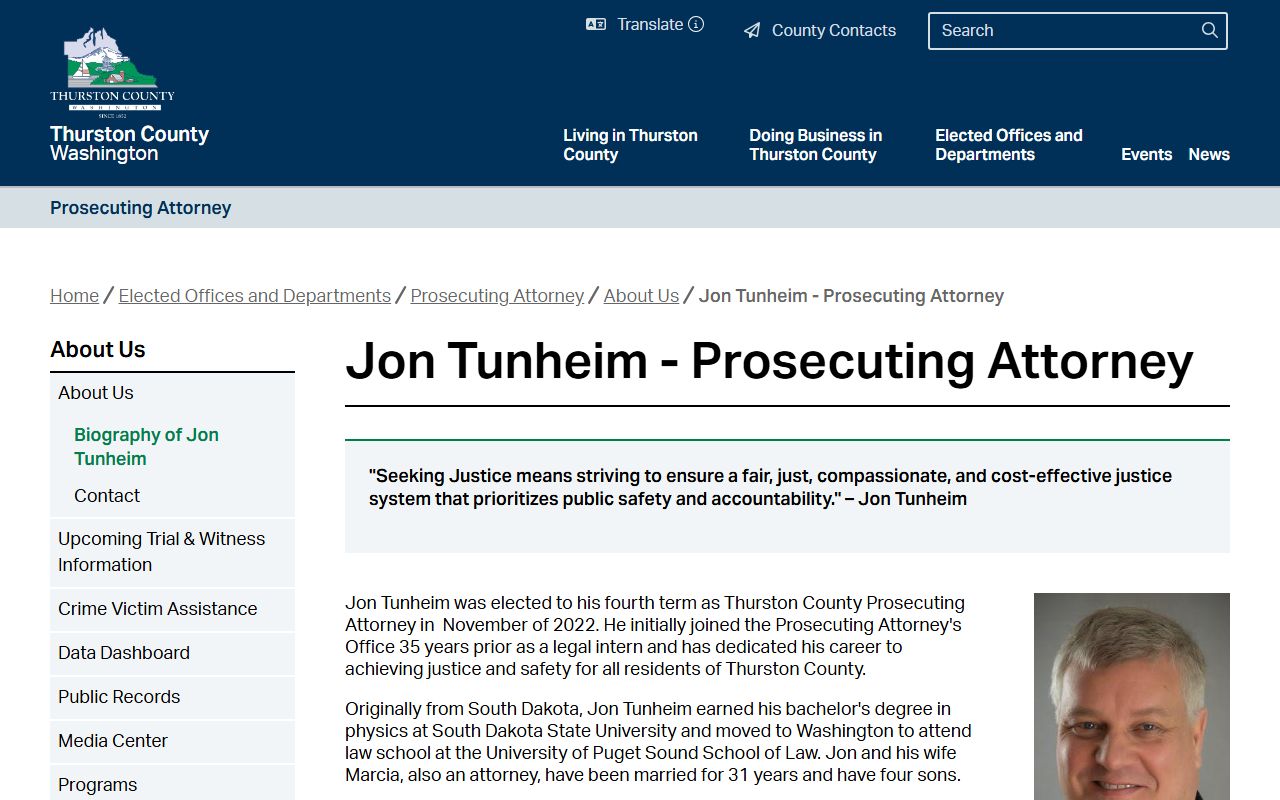
That page introduces the prosecutor whose office files the cases you see in court records. The office sits at 2000 Lakeridge Drive SW, Olympia, WA 98502, and its phone is 360-786-5540. Because the prosecutor controls charging, the office is where a charge becomes a filed case and, in time, part of the public record.
Sealing, Vacating, and Juvenile Records
Washington does not use the word "expunction" the way some states do. Adult relief is usually called vacation of a conviction. Felony vacation runs under RCW 9.94A.640, and misdemeanor or gross misdemeanor vacation runs under RCW 9.96.060. Each has its own eligibility test and waiting period. A person files a motion in the court of conviction, serves the prosecuting authority, shows they qualify, and gets a signed order. Vacation sets the conviction aside, but it does not always erase every historical trace.
Juvenile records follow a separate track. You can review the juvenile sealing statute on the state legislature site at RCW 13.50.260.
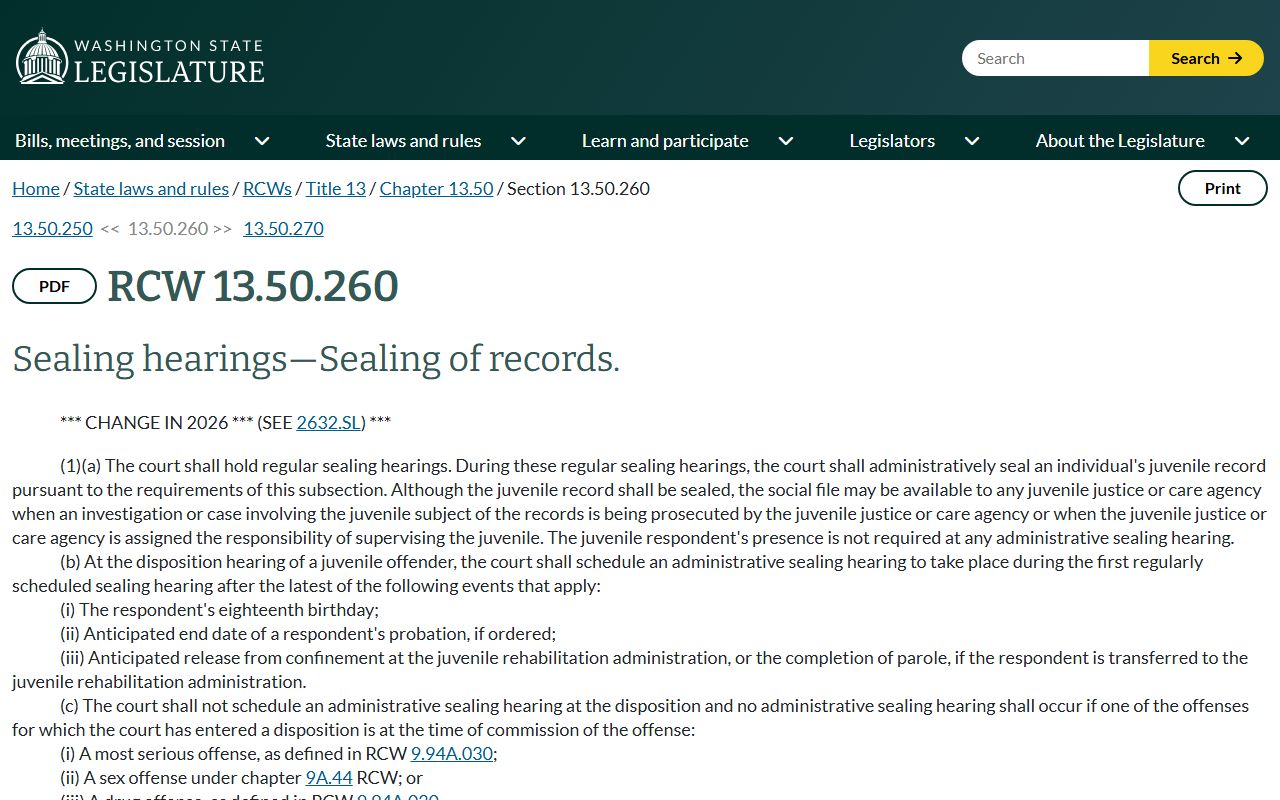
That statute provides both administrative and petition-based sealing for juvenile records, while still allowing certain agencies access for set purposes. Sealing and vacation are not the same thing, and the table below sorts them out.
| Point | Sealed Record | Vacated Conviction |
|---|---|---|
| What it does | Protects the record from public inspection. | Sets aside a conviction under statute. |
| Common use | Juvenile records and court files under GR 15. | Adult felony or misdemeanor convictions. |
| Who may still access | Law enforcement, courts, or specified agencies. | Some historical references can remain. |
| Main authority | RCW 13.50.260 and GR 15. | RCW 9.94A.640 and RCW 9.96.060. |
Note: a denied request often turns on a disqualifying offense, new pending charges, unpaid obligations, or too short a waiting period.
Public Defense and Indigency Standards
An arrest can lead to charges, and a person who cannot afford a lawyer still has a right to one. Thurston County Public Defense fills that role. It represents people accused of crimes who cannot pay for counsel, and it also represents low-income youth, parents in dependency cases, and adults facing civil commitment. The main office sits at 926 24th Way SW, Olympia, and its phone is 360-754-4897.
You can learn how this office serves the accused on the Thurston County Public Defense page.
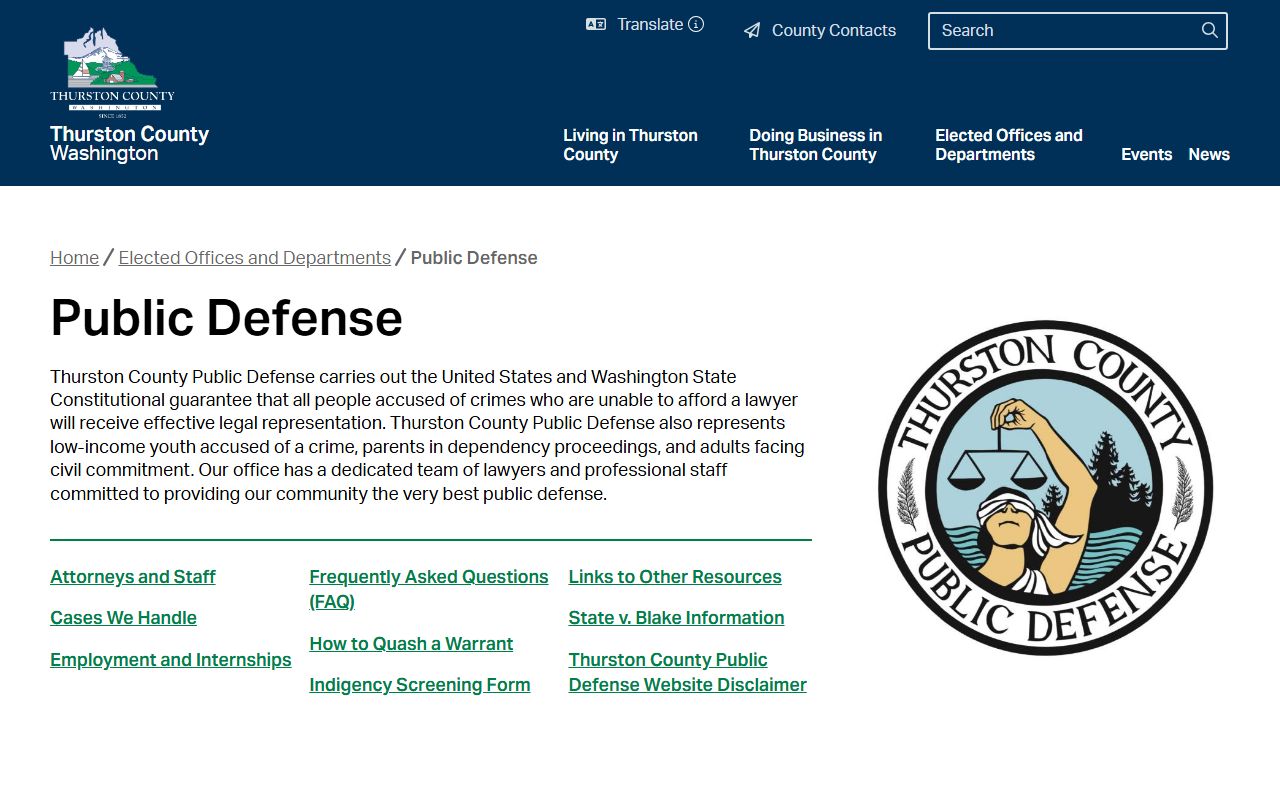
That page lays out the mission to defend the constitutional rights of each client. To qualify, a person has to be screened for indigency. Washington's Office of Public Defense explains how that screening works on its indigency screening page.
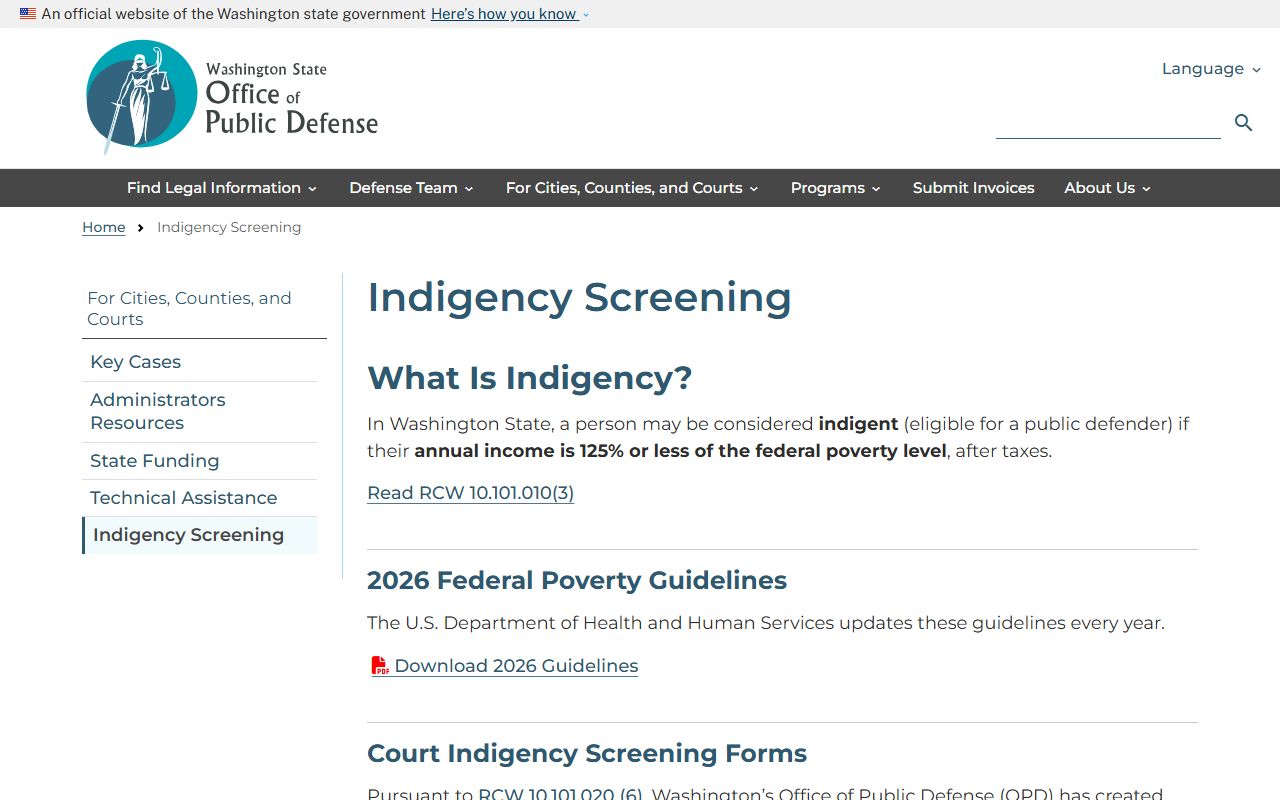
The screening page sets out the income test the courts use before they appoint a lawyer. A person may be found indigent if annual income is 125% or less of the federal poverty level after taxes. That benchmark comes from RCW 10.101.020.
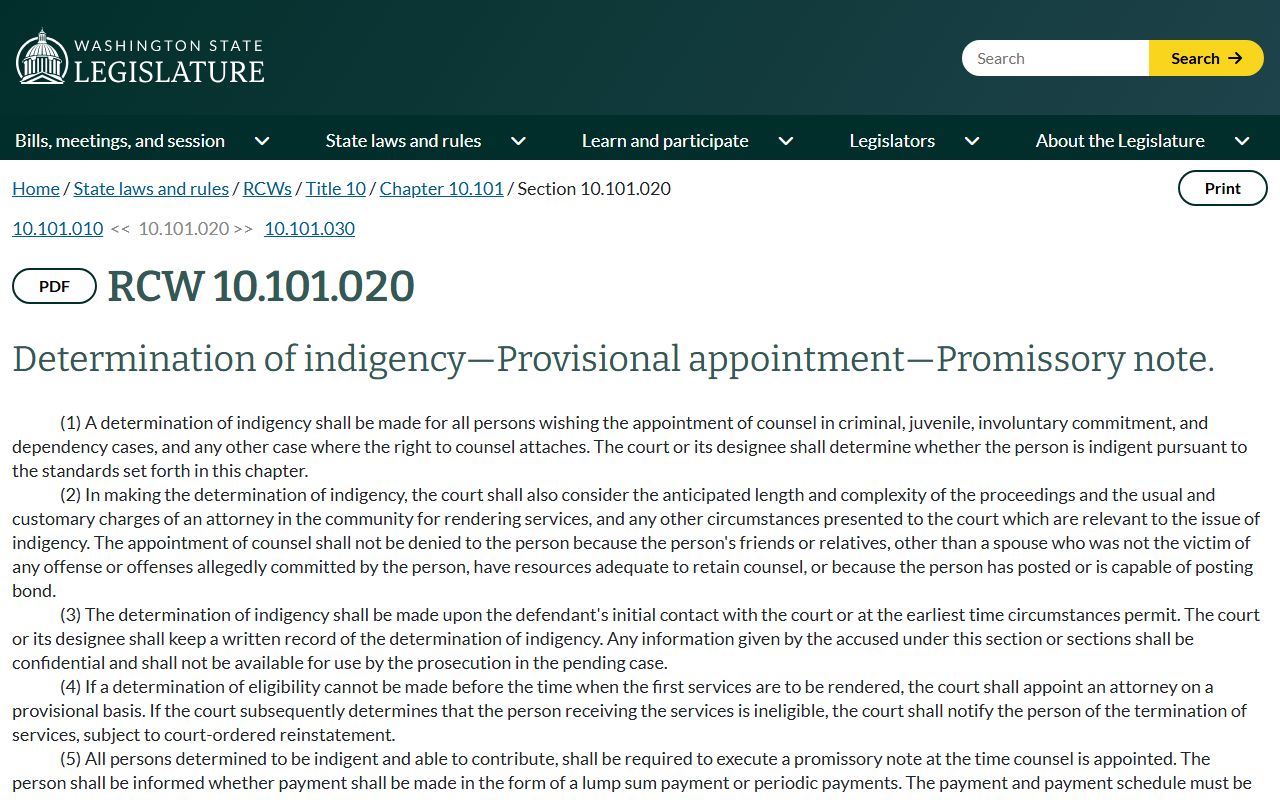
That statute defines the indigency standards the court applies when it decides whether to appoint counsel. So the booking record may start a case, but indigency screening decides who gets a public lawyer to fight the charges that follow.