
How to Search Thurston County Traffic Court Records
Most traffic cases in Thurston County are handled in District Court. That matters for your search, because District Court does not use the same portal as Superior Court. Open District Court records are pulled through a system called WebLink. To land on the right file there, you need two things: the case number and the law enforcement agency that wrote the ticket. Without both, the lookup will not find the case. More about that court sits on the Thurston County District Court page.
If you do not have the case number yet, start with the paper you already hold. A ticket or a court notice shows it. The statewide Person Search can also point you to a number first. Once you have it, much of a traffic case can be handled online. People review documents, pay tickets, ask for deferrals, and file written statements without a trip downtown.
- Find your case number and the citing agency on the ticket or court notice.
- Open the District Court WebLink system to view open traffic records.
- Enter the case number and select the law enforcement agency.
- Review the citation, the charge, the court date, and any finding.
- Pay, defer, mitigate, or contest the ticket within the response window.
The lookup needs both fields filled in. The table below lays out what each one is.
| Field Label | Type | Required | Notes / Format |
|---|---|---|---|
| Case Number | Text | Yes | Found on the ticket or court notice; the main case ID. |
| Law Enforcement Agency | Selection | Yes | The agency that wrote the citation or report. |
| Search | Button | Action | Runs the WebLink lookup for open records. |
Note: An online index is a search tool, not the full official file, so confirm complete records with the court that holds the case.
Which Courts Handle Traffic Cases in Thurston County
Not every ticket lands in the same court. County and state citations, and tickets written by law enforcement under state law, are mainly handled in District Court. City ordinance and city traffic matters may route to a city's municipal court instead. So a ticket written inside Olympia, Lacey, or Tumwater on a city law could be a municipal court case, not a District Court one. The rule of thumb: county or state law citations go to District Court unless filed elsewhere, while city ordinance citations go to that city's court.
DUI and other serious driving crimes are a different animal. They are criminal matters, not ordinary civil infractions, and they follow the criminal track. Felony driving cases route to Superior Court. Some cities also run a traffic violation bureau, which processes minor traffic violations with no jail risk to speed things up. If a city uses one, its records and payment steps may be city-specific.
For background on the county's higher court, the official site offers a lead-in. The Thurston County Superior Court page describes the court that handles felony driving cases and appeals from the limited jurisdiction courts.
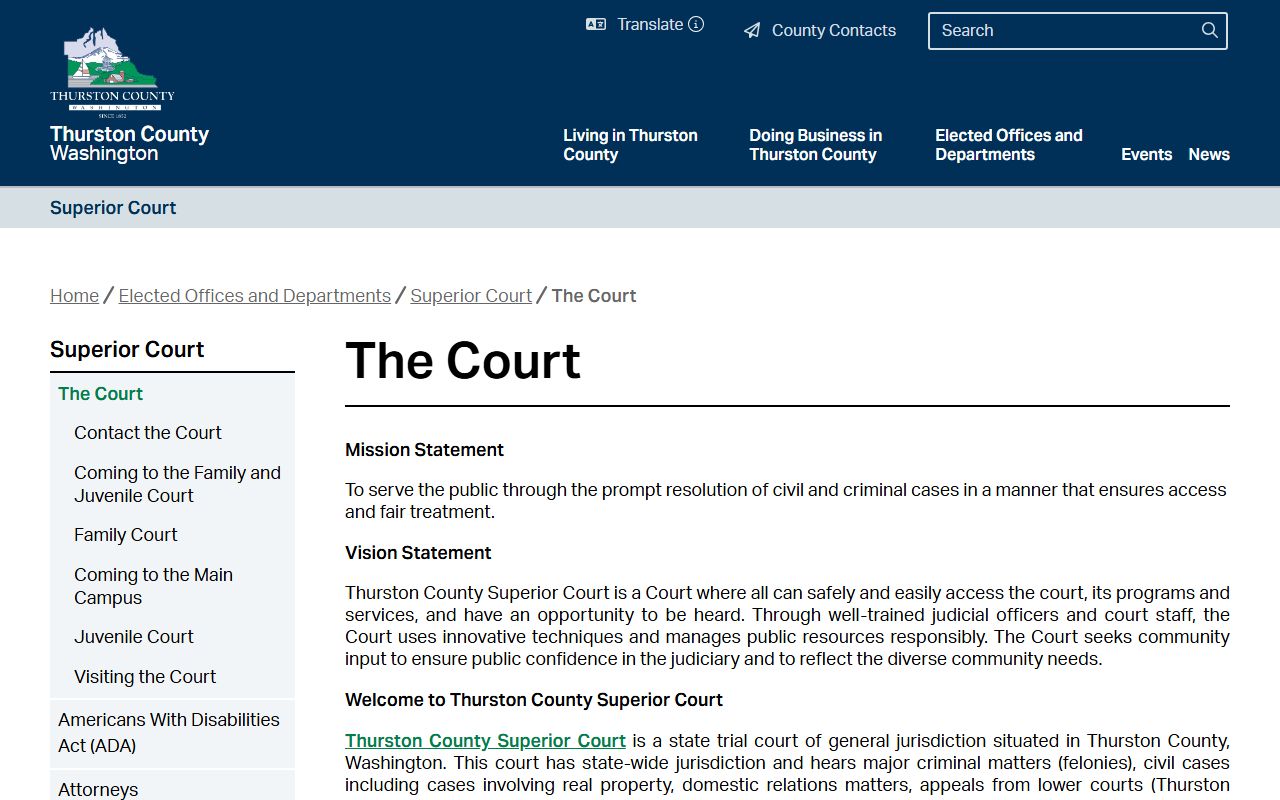
That court hears the serious driving crimes and the appeals, while routine traffic infractions stay down in District Court or a city court.
Types of Traffic Cases on Record
Traffic files span a wide range, from a minor speeding ticket to a criminal driving charge. Some are civil infractions you simply pay or contest. Others are crimes that carry the weight of a criminal case. The mix below shows the main kinds a search may turn up in Thurston County.
- Traffic infractions, such as routine moving violations.
- Nontraffic infractions tied to a citation.
- Speeding, including speed in a marked zone.
- DUI and DWI, which are handled as crimes.
- Driving while license suspended.
- Reckless driving.
- Operating a vehicle with no insurance.
A civil infraction and a criminal charge do not search or resolve the same way. The criminal ones can carry jail risk and a tougher process.
What Thurston County Traffic Court Records Show
A traffic case file is built around the citation. It ties the ticket to a person, a charge, a court date, and a result. Much of that data is open to view, though some financial detail and protected identifiers stay out of public sight. The inventory below maps the fields a traffic record tends to hold.
| Field | What It Shows |
|---|---|
| Citation Number | The ticket ID used to find the case. |
| Defendant Name | The person the ticket was written to. |
| Cited Statute / Infraction | The law or rule said to be broken. |
| Law Enforcement Agency | The agency that issued the citation. |
| Filing / Court Date | When the case was filed and the court date set. |
| Hearing Type | Mitigation, contested, or other hearing kind. |
| Finding | Whether the infraction was committed or not. |
| Fine / Penalty | The amount owed on the ticket. |
| Payment Status | Paid, due, or in some other state. |
| DOL Reporting | Whether the result was reported to Licensing. |
Searching by Citation Number vs by Name
The fastest path is the citation number. With it, plus the citing agency, the District Court WebLink lookup goes straight to the case. There is no guessing and no sorting through similar names. So if you have the ticket, use it.
No citation number? You still have options. Pull the number from a ticket or a court notice first. If neither is handy, the statewide Person Search can help you find the case, and from there the number. Once you know the number, switch back to the District Court system for the open traffic record. A name-only search is broader and may turn up more than one match, which is why the number wins when you can get it.
Paying or Contesting a Thurston County Traffic Ticket
The clock starts the day you get the ticket. District Court says the person must respond within 30 days of the date the ticket was received. Miss that window and the amount owed can go up, and the case can lead to a driver's license suspension. The court tells people to read the entire ticket before picking a response. Your choices are to pay, ask for a deferral, ask for mitigation, or set a contested hearing.
Each option sends the case down a different path. Paying ends it. A deferral can keep the ticket off your record if you meet the terms. Mitigation admits the violation but asks for a break. A contested hearing puts the question to the judge. The steps below cover the response in order.
- Read the whole ticket so you know the charge and the deadline.
- Pick a response: pay, deferral, mitigation, or contested hearing.
- Submit your choice within 30 days of getting the ticket.
- For a deferral or mitigation, follow the form or e-request steps.
- Wait for the court's notice or decision, then meet any conditions.
Note: Doing nothing is the worst choice, since failure to respond can raise the amount owed and start a license suspension.
Deferral of a Traffic Infraction
A deferral can keep a ticket off your driving record, but it has rules. The request must come within 30 days. Not everyone qualifies. District Court lists three bars to eligibility, and any one of them can rule you out.
- A deferral granted within the last seven years.
- A commercial driver's license held in any state.
- An excluded infraction, listed below.
The excluded infractions named by the court include passing a school bus, speeding in a construction zone, and any infraction where a fatality occurred. For driving without insurance, proof of insurance may be shown when you request the deferral. If you do qualify, the court sets conditions. You pay the administrative fee, pay an added $70 for each extra charge on the ticket, and commit no new traffic infractions for six months.
Meet the terms and the ticket is dismissed and not reported to Licensing. Fall short and a committed finding is entered and reported to the state. A $52 penalty may be added for failing to pay the administrative fee. The court may also enter a failure-to-respond order and notify Licensing to begin suspension processing.
Mitigation Hearings for Traffic Tickets
Mitigation is the middle road. You admit the violation but explain the circumstances to the judge and ask for a reduction. The trade-off matters: mitigated infractions are reported to Licensing and show on your driving record. The request must be made within 30 days, like the others.
There are a few ways to do it. For an in-person or Zoom hearing, you check the "Mitigation Hearing" block on the ticket and mail it to District Court, with notice expected in about two weeks. E-mitigation is the online route. You complete a form and email it to DC_eRequests@co.thurston.wa.us, and the judge reviews the request and decides the case. The response is sent within 4 to 6 weeks to the email on the form. Mitigation by mail uses a letter explaining the circumstances along with a copy of the ticket.
Contested Hearings for Traffic Cases
A contested hearing is for when you deny committing the infraction. You want the judge to decide based on evidence and testimony. If the judge finds the infraction committed, the result is reported to Licensing and appears on the driving record. The request must be within 30 days.
One thing to know before you choose this: once an infraction has been contested, the option to request mitigation or a deferral is no longer on the table. The court does allow an electronic written statement in place of appearing, but not if you plan to subpoena witnesses. If you switch from an in-person hearing to an e-contested one, the request form must be received at least three business days before the hearing, and you must give a valid email address.
Public Access Laws for Traffic Court Records
Court records in Washington are open as a default. Court case files, including traffic files, fall under court rule GR 31, which presumes public access to dockets, orders, findings, and calendars. So the traffic case file is generally a public record you can view.
Open does not mean wide open. Protected identifiers are redacted, such as Social Security numbers, some addresses, and minor information. A file can be sealed or limited by court order, statute, or privacy rule. For the broader access framework, the Thurston County court records page covers how Washington splits court files from agency records.
Note: A traffic case search shows the court file, not the official state driving abstract, which the Department of Licensing keeps separately.
Court Traffic Records vs State Driver Records
People often mix these up, but they are two different files held by two different offices. The court traffic record is the case file at the District or municipal court. The state driver record is your driving history at the Department of Licensing. One tracks the court case; the other tracks your license and driving privilege. The comparison below lines them up.
| Point | Court Traffic Record | State Driver Record |
|---|---|---|
| Maintained by | District or municipal court | Washington Department of Licensing |
| Main identifier | Citation or case number, citing agency | Driver license or customer record |
| What it shows | Citation, hearing, finding, fine, deferral or contest result | Reported infractions, license status, suspensions |
| Used for | Court case management, payments, hearings | Licensing, insurance, driving privilege |
| How updated | By the court clerk and case system | Licensing receives court reporting |
Because they are separate, a result in the court file gets reported to Licensing, which then updates the driving record. Fix an error in the right place: a court file issue goes to the court, a driving record issue goes to Licensing.
DUI and DWI Cases in Thurston County
DUI and DWI are not ordinary infractions. They route to criminal handling, with the process and stakes of a criminal case. That means they do not pay off like a simple ticket, and they can carry jail risk. For how the county treats criminal driving matters, see the Thurston County arrest records page.
The county also runs a treatment-based program for some of these cases. Superior Court operates a DUI and Drug Court, a problem-solving court aimed at treatment over plain punishment. The program page gives the official lead-in. The Thurston County DUI Drug Court page describes the treatment program for qualifying DUI and drug cases.
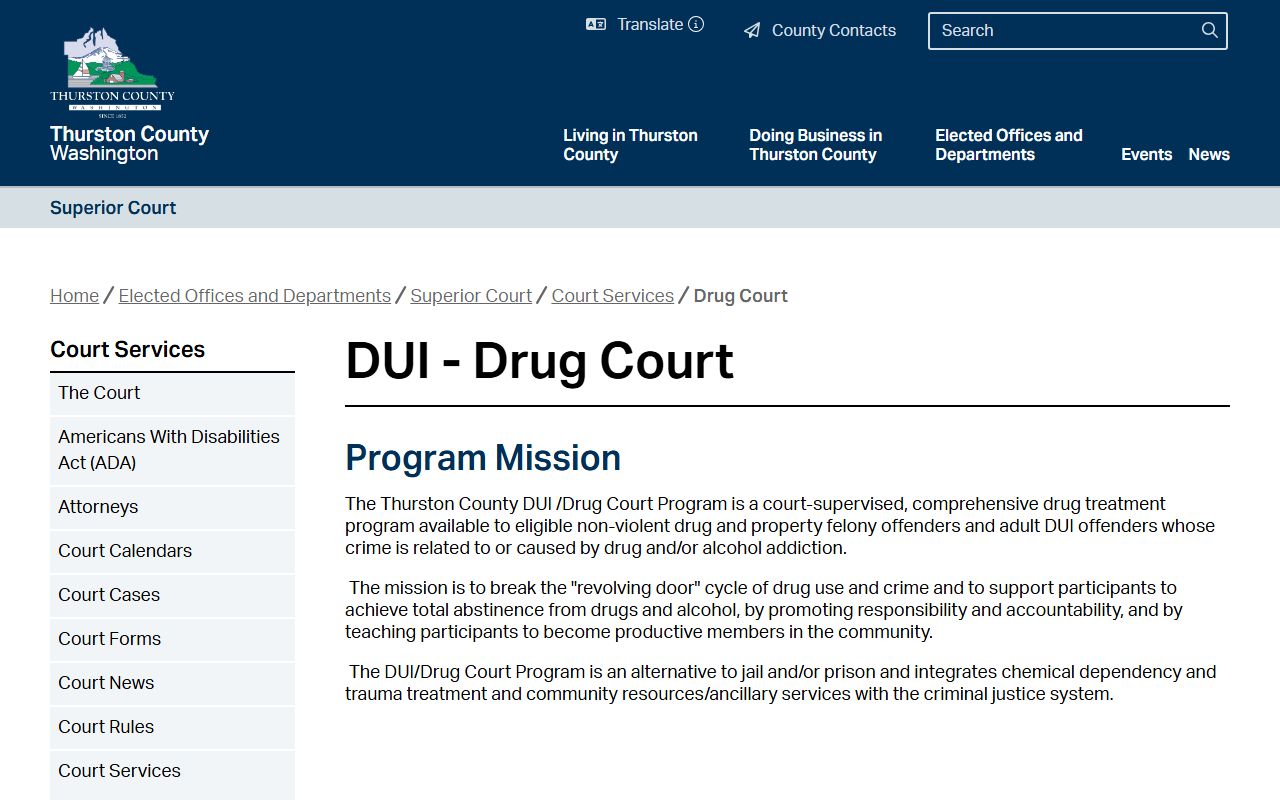
So a DUI case can run through Superior Court and a treatment track, far from the quick path a routine traffic ticket takes.
Fees and Related Traffic Records
Traffic fees come up in a few places. The deferral path carries an administrative fee, plus an added $70 for each extra charge listed on the ticket. If you get a deferral and then fail to pay that administrative fee, a $52 penalty may be assessed. Those are the dollar figures the District Court ticket page made clear.
One honest gap: the current ticket-payment vendor's card or service fees were not harvested from the dynamic payment page, so no figure is given here for those. Confirm any card or processing fee directly with the court at the time you pay.
Traffic records often connect to other files. You may also want Thurston County court records for the full case index, the arrest records page for criminal driving matters, the District Court page for the court that hears most tickets, or the Thurston County Clerk of Court for Superior Court copies and certified documents.