
Probate in Thurston County Superior Court
Probate is not its own court here. It lives inside the Superior Court, and the County Clerk holds the files. When someone dies and an estate needs to be settled, the case is opened as a Superior Court cause number through the Clerk. That is the same office that handles felony, civil, and family files. The Clerk takes the petition, opens the case, and later issues the court's letters. A judge or commissioner signs the orders that give an estate's representative legal power.
One thing trips up many people. The Clerk does not hand out probate forms or packets. The office states plainly that it does not provide probate forms, and it advises people to research Washington State probate or to talk with an attorney. That is a real gap to plan around. Whether an estate even needs probate is its own question, and the Clerk calls it complicated and best answered by a lawyer. Some small estates can pass without a full probate case at all.
The Superior Court page is a good first stop for hours, contacts, and case basics. The Thurston County Superior Court page lays out the trial court that hears probate, guardianship, and estate matters for the county.
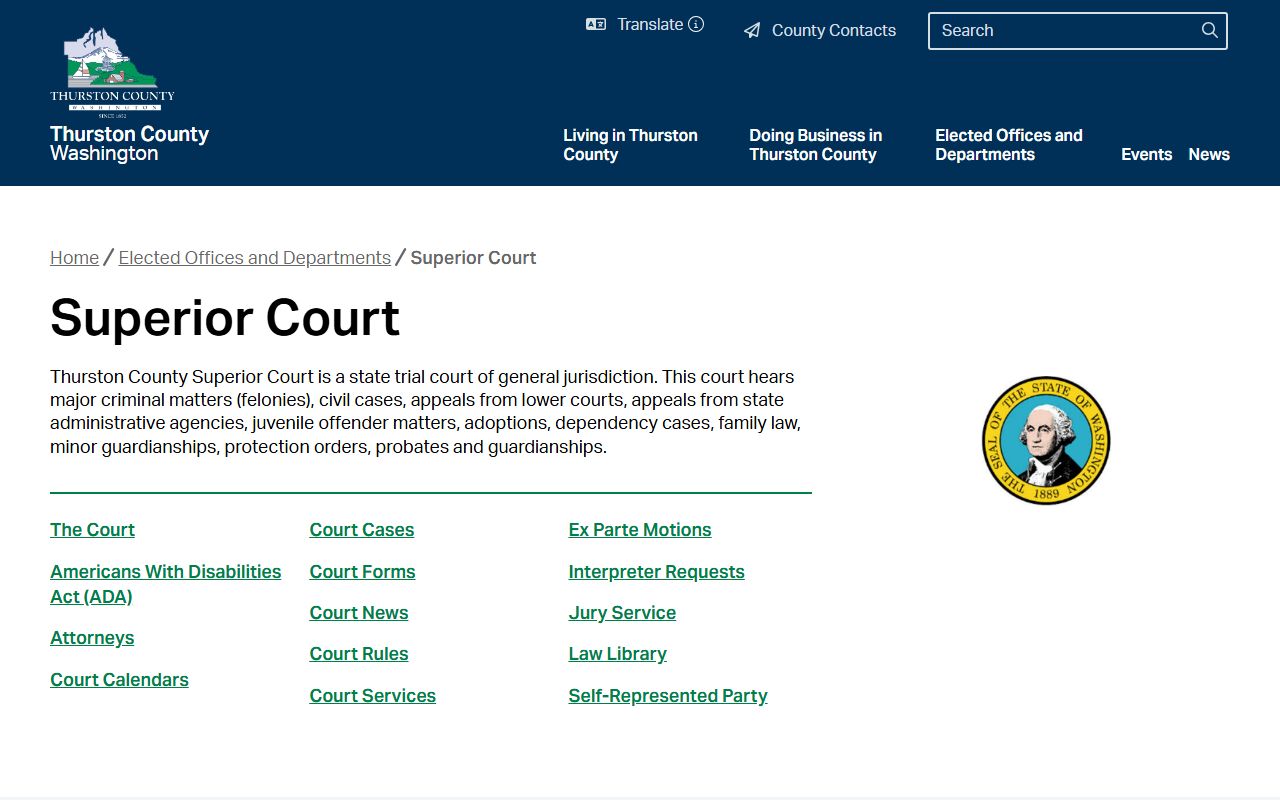
That same court is where the petition is filed and where a judge signs the order that opens the estate, so it anchors the whole probate path in Thurston County.
Starter Documents to Open Probate
To open an estate, a set of papers gets filed at once. The Clerk lists the exact documents needed to start a probate case. You will not find a fill-in packet from the office, so each piece is prepared on your own or with help from an attorney. Get them ready before you file. A missing death certificate or an unsigned oath can stall the whole case at the counter.
- Case Cover Sheet - the form that opens the Superior Court cause.
- Petition - the request to open probate and appoint a representative.
- Original Will - the actual will, if the person left one.
- Certified copy of the Death Certificate - proof the person has died.
- Oath - signed and notarized by the proposed representative.
- Order Admitting Will and Issuing Letters Testamentary - the proposed order when there is a will.
- Order Granting Letters of Administration - the proposed order used instead when there is no will.
Note: The proposed order you bring depends on the will; a will calls for letters testamentary, while no will calls for letters of administration.
Thurston County Probate Filing Fees
Opening an estate costs money up front, and copies add more later. The Clerk charges a set fee to file a probate case and a small fee to issue each court letter. On top of that, any copies of filed documents follow the Clerk's standard copy rates. The table below puts the main probate costs in one place.
| Item | Fee |
|---|---|
| Probate filing fee | $290.00 |
| Issued probate letter | $5.00 |
| Non-certified hard copy | $0.50 per page |
| Non-certified electronic copy | $0.25 per page |
| Certified copy | $5.00 first page + $1.00 each added page |
Certified letters matter the most in probate. Banks, title firms, and other holders of estate assets often want a certified letter before they will deal with the representative. So the $5 letter fee is one many estates pay more than once. Plain copies work for your own files, but a certified copy carries the court's seal and proof that it is true.
The Probate Process Step by Step
The path from death to a closed estate runs in a set order. Each step builds on the one before it. The Clerk and the court each play a part, but the work of gathering papers and serving notices falls on the estate's representative. The walkthrough below shows the main steps in order.
- Decide if probate is even needed. The Clerk calls this complicated and points you to an attorney.
- Prepare the documents: cover sheet, petition, original will if any, certified death certificate, notarized oath, and the proposed order.
- File the case in Superior Court through the Clerk and pay the $290 filing fee.
- Present the proposed order to the court. Ex parte services were suspended effective March 16, 2026 until further notice, so verify the current process before you go.
- If the court grants the petition, the Clerk issues letters for $5 each.
- The personal representative administers the estate: notices, inventory, creditor handling, asset management, and final accounting or closing as required.
The suspended ex parte step is the part most likely to change. Older guides may still tell you to walk an order into an ex parte calendar. With that service paused, the court may handle proposed orders a different way for now. Check the current process with the court or Clerk before you rely on any printed steps.
Note: The ex parte suspension that began March 16, 2026 has no set end date, so confirm how the court takes proposed probate orders before you file.
Letters Testamentary and Administration
Letters are the heart of a probate case. They are the court's written proof that a named person has power to act for the estate. Without them, banks and other holders will not release assets. There are two main kinds, and which one the court issues turns on whether the person left a will.
Letters Testamentary go to an executor after a will is admitted to the court. The will names who should serve, and the court confirms it. Letters of Administration are used when there is no will. The court appoints an administrator to settle the estate under state law instead of a will's terms. Both give the same basic power to manage and close the estate, but they start from different facts. The terms below come up again and again across probate files.
- Testator
- The person who made the will.
- Executor
- The person named in a will to settle the estate.
- Intestate
- Dying without a valid will.
- Personal Representative
- The executor or administrator who manages the estate.
- Guardianship
- A court appointment for personal or health decisions.
- Conservatorship
- A court appointment for financial or property decisions.
Searching Thurston County Probate Cases
Probate cases search the same way as other Superior Court files. The Odyssey Portal holds the public case and hearing data for the county's Superior Court, and probate sits right alongside civil and family cases. Search by case title or by cause number. Public case information is free to view. The documents themselves are a separate matter and are not open to anonymous web users.
For the actual filed papers, the Clerk sells them. Clerk Documents lets you search by cause number and buy the public documents that are online. When a document is not online, you can request a copy by email or mail and the Clerk will reply with a page count, the cost, and a payment link. The fields a probate file usually shows are listed below so you know what to look for in a result.
- Cause number and estate name
- Decedent and the petitioner or personal representative
- Attorney of record and filing date
- Probate case type and docket entries
- Orders, issued letters, and any will filing
- Inventory or accounting entries and hearings
You can reach both tools through the county. Use the Odyssey Portal for case and hearing info, and use Clerk Documents to buy available estate filings by cause number.
Guardianship and Confidential Restrictions
Not every part of a probate or estate matter is open. Probate cases often touch guardianship and conservatorship, and those files can carry sensitive details. Some of that information is restricted by rule. Health and medical facts in particular may be closed to public view even when the rest of a case is open.
This matters for any search. A confidential guardianship, conservatorship, or medical record may not show in a public result, or may show only in part. If you are a party and need a closed document, the Clerk handles confidential viewing for people connected to the case, and a court order may be needed for the rest.
Note: Confidential guardianship, conservatorship, and medical information may be restricted, so some estate details are not open to the public and will not appear in an ordinary search.