
Two Kinds of Thurston County Public Records
Not every record is reached the same way. Washington keeps two separate access tracks, and most confusion starts right here. One track covers records made or held by county agencies. The other covers files created in a court case. A request to the Sheriff for a report is not the same as a request to the Clerk for a filed court document. Each track has its own law, its own forms, and its own list of what stays closed.
Agency records come from offices like the Sheriff, the jail, the Prosecuting Attorney, the Auditor, and the Assessor. These follow the state Public Records Act. You ask the agency that holds the record. They respond on a set timeline and can charge for copies. Court case records are a different animal. A divorce file, a criminal docket, or a civil judgment lives with the court, and the rules that open it come from the courts, not the Public Records Act.
So the first step is to name the record. Then you know which office to ask and which law applies. Sending a court-document request to a county web form, or a sheriff-report request to the court Clerk, just slows you down.
The two tracks have real overlap in feel but not in law. Both presume openness. Both have limits. The difference is which body decides what stays public.
- Agency records - sheriff, jail, prosecutor, auditor, and assessor files under the Public Records Act.
- Court case records - dockets, orders, judgments, and case files governed by court rules.
- Recorded documents - deeds and marriage records held by the Auditor as the county recorder.
- Criminal history - kept by the Washington State Patrol, not by a court case search.
Note: A jail roster lookup or a court docket search is not an official criminal history report; the Washington State Patrol holds the state's criminal history record data.
The Washington Public Records Act
County agency records fall under the Public Records Act, found at RCW chapter 42.56. The law gives the public a right to inspect and copy agency records. It also lists exemptions, sets copy charges, and builds in a response framework. It does not, by itself, control access to court case files. Those follow court rules instead.
The Public Records Act is shown here in full text.
The state legislature posts RCW chapter 42.56 with every section of the Public Records Act for anyone who wants to read the law itself.
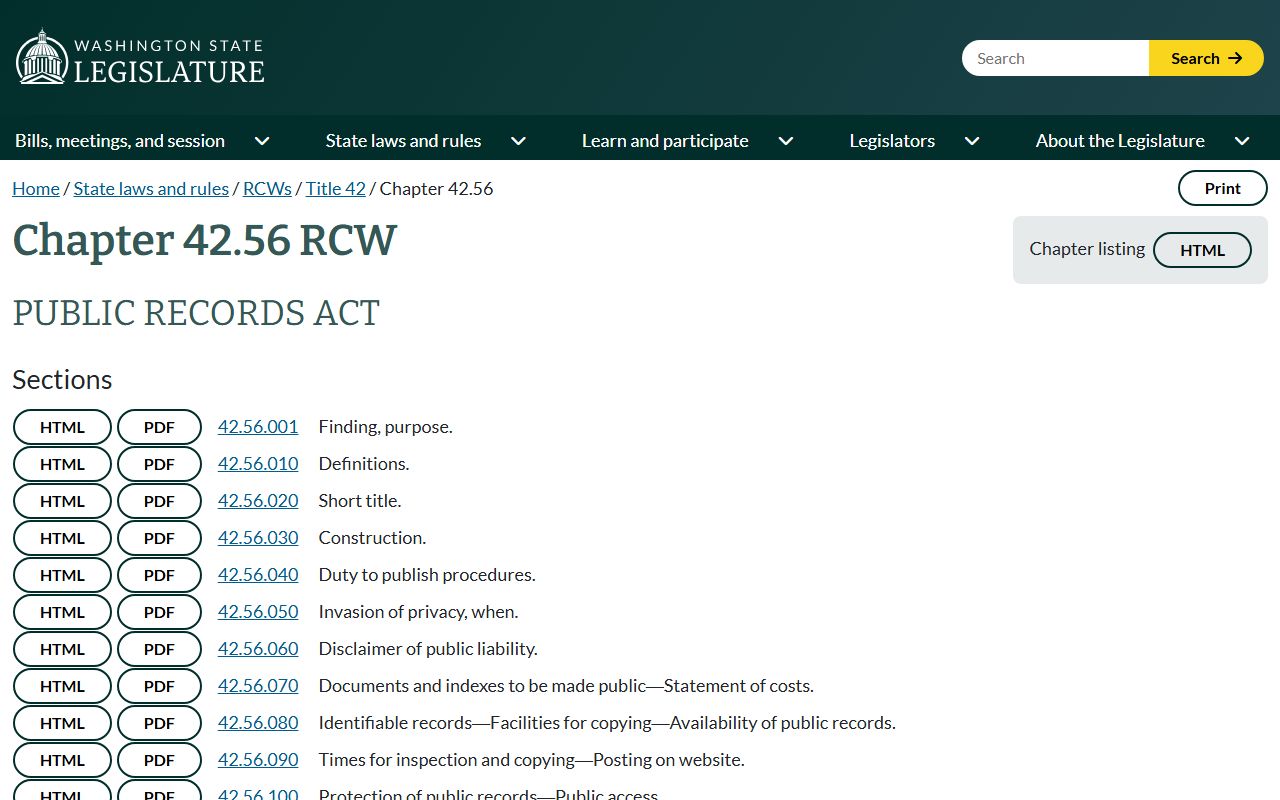
That full text spells out the duties an agency owes once a Thurston County public records request lands in its inbox.
An agency must answer within five business days. It can do one of several things. It may provide the records. It may acknowledge the request and give a reasonable estimate of the time needed. It may seek clarification when the request is unclear. It may deny the request, but only with a citation to the exemption that applies. Or it can point you to a link or access path where the records already sit.
Exemptions have to be cited, not just claimed. When only part of a record is exempt, the agency should still produce the rest with the protected parts redacted. The default is disclosure. A blanket refusal without a legal basis does not meet the law.
Court Records Under GR 31
Court case records run on a separate rule. Access to them comes from GR 31, a statewide court rule, not from the Public Records Act. GR 31 presumes that court records are open. The list it covers is broad. It includes dockets, orders, judgments, calendars, registers of actions, official records of proceedings, minutes, and case-management information tied to a case.
GR 31 reads "access" as the ability to view or get a copy of a court record. The openness it sets rests on the state constitution's open-courts principle, balanced against privacy. A few things are left out of the definition. Judge notes, draft memos, and working papers for a case are not court records. Neither is information held by some other agency that the court can reach but never entered into the file.
A second rule, GR 31.1, covers judicial administrative records rather than case files. Think court management, supervision, committees, and branch administration. Those also presume access, with their own exemptions for privacy, statutes, and the integrity of judicial decisions.
For Thurston County, the Clerk holds the Superior Court case files. District Court keeps its own limited-jurisdiction records. So a court-record request goes to the court of record, while an agency request goes to the agency.
How to File a Thurston County Public Records Request
Filing a request for agency records is a short process when you prepare first. The key is to ask for identifiable records. An agency does not have to answer a vague fishing request, but it must respond to a clear one. Name the office, name the records, and give enough detail that staff can find what you mean.
The steps below track the Public Records Act framework for county agency records.
- Identify the agency that holds the records and describe the specific records you want.
- Submit an identifiable written request, often through the county public records web form.
- Wait for the five-business-day response, which may provide records, give an estimate, seek clarification, deny with a citation, or share an access link.
- Pay any copy costs the agency charges before files are released.
- Appeal a denial or seek court review if you believe an exemption was misapplied.
Court review is a real option. The Public Records Act lets a requester ask a court to review a denial. In proper cases, a requester may recover penalties and fees. Special limits apply to incarcerated requesters, who generally cannot collect penalties unless the agency acted in bad faith. For court case documents, skip the agency form and go to the Clerk or the court of record instead.
Public Records Request Form Fields
The county routes many agency requests through an online public records form. The static fields the request relies on are simple. You give your contact details, describe the records, and say how you want them delivered. Because the county form is built on a dynamic Formsite system, the full set of fields was not fully harvested, so the form may ask for added details once you open it.
| Field / Requirement | Type | Required | Notes |
|---|---|---|---|
| Requester contact | Name, email, phone | Yes | Needed so the agency can respond and bill copy costs. |
| Description of records | Text | Yes | Must identify the records; vague requests can be returned for clarification. |
| Agency / department | Selection | Yes | Pick the office that holds the records, such as Sheriff or Assessor. |
| Format preference | Selection | No | Electronic copies or paper copies where available. |
| Delivery method | Selection | No | Email link, mail, or pickup, subject to the agency. |
| Added Formsite fields | Dynamic | Varies | The form may ask for more once loaded; exact fields not fully captured. |
Keep the description tight. A request that names a date range, a case or incident number, or a clear subject moves faster than one that asks for everything an office ever made.
Sheriff and Jail Records
Records from the Sheriff and the county jail are agency records under the Public Records Act, but they carry extra limits. Law-enforcement exemptions in RCW 42.56.240 can restrict active or sensitive investigative material. Privacy interests and operational-security concerns can also affect what comes out. So a request for a sheriff report or jail material may return less than the full file, or come back with redactions.
The Sheriff's Office page is shown here.
The Thurston County Sheriff page lists the office and points to how the agency handles public records requests for its files.
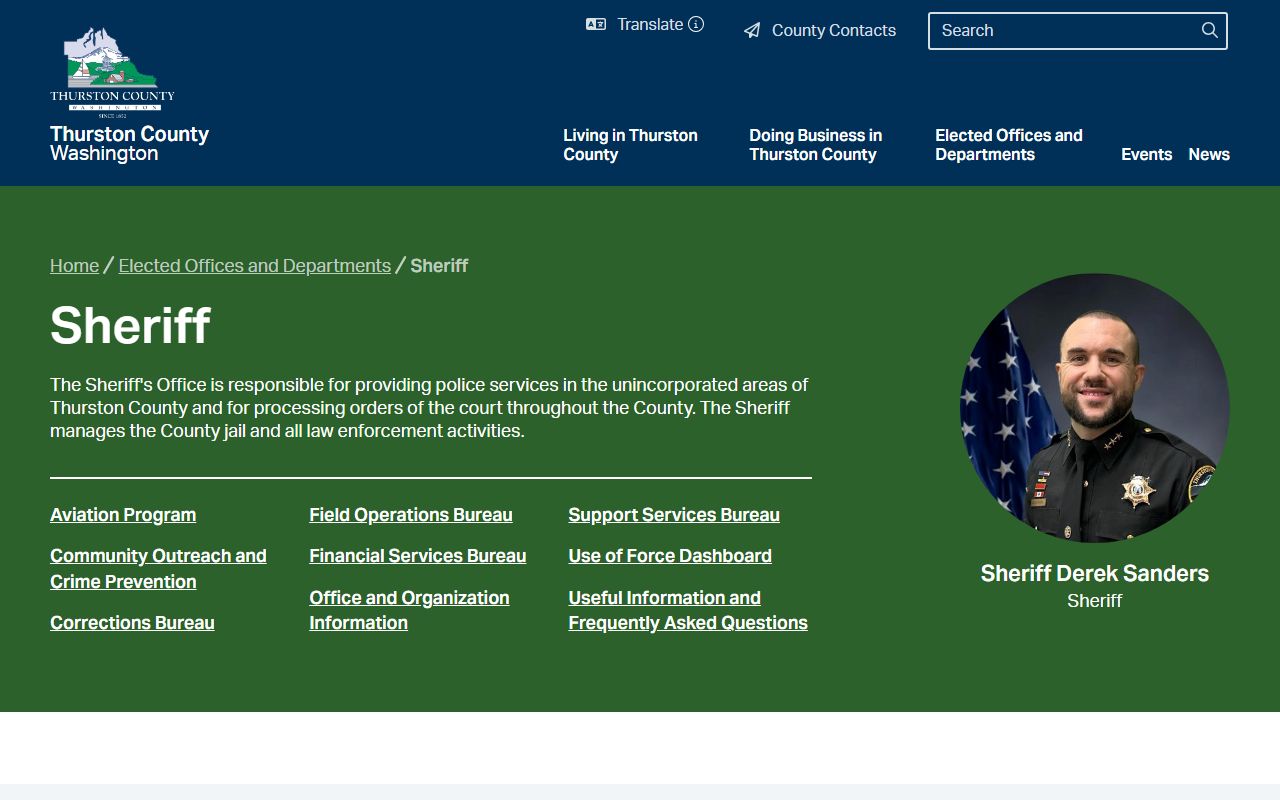
That page is the front door for sheriff administrative and jail records, which are not the same as a court case file.
One point trips people up often. Jail roster data is custody and booking information. It is not a criminal-history report. The roster shows who is held and basic booking facts. It does not show a full record of past convictions, and it is not the official state criminal history. For that, the Washington State Patrol is the channel. Body-camera, jail-security, and active-investigation material may all be affected by the same law-enforcement and privacy exemptions.
Clerk and Auditor Copy Fees
Copy costs depend on which office holds the record. Two county offices publish their own fee schedules. The Clerk handles Superior Court case documents. The Auditor handles recorded documents like deeds and marriage records. Their rates differ, so a side-by-side view helps before you order.
| Copy Type | Office | Fee |
|---|---|---|
| Non-certified hard copy | Clerk | $0.50 per page |
| Non-certified electronic copy | Clerk | $0.25 per page |
| Certified copy | Clerk | $5.00 first page + $1.00 each added page |
| Photocopy | Auditor | $1.00 per page |
| Certified recorded-document copy | Auditor | $3.00 first page + $1.00 each added page |
Agency copy fees under the Public Records Act work a bit differently. They rest on the statutory default fee authority or a fee schedule the agency has adopted. The Clerk and Auditor rates above are the published local court-related fees, and they apply to the documents those offices hold.
Federal Records and PACER
Federal case records are not county public records. Thurston County sits in the U.S. District Court for the Western District of Washington. A federal civil, criminal, or bankruptcy matter is filed there, and the county Public Records Act does not reach those files. Federal dockets and documents are searched through a separate national system.
The PACER registration page is shown here.
You can sign up at PACER, the official federal docket and document system, to search and download federal case files.
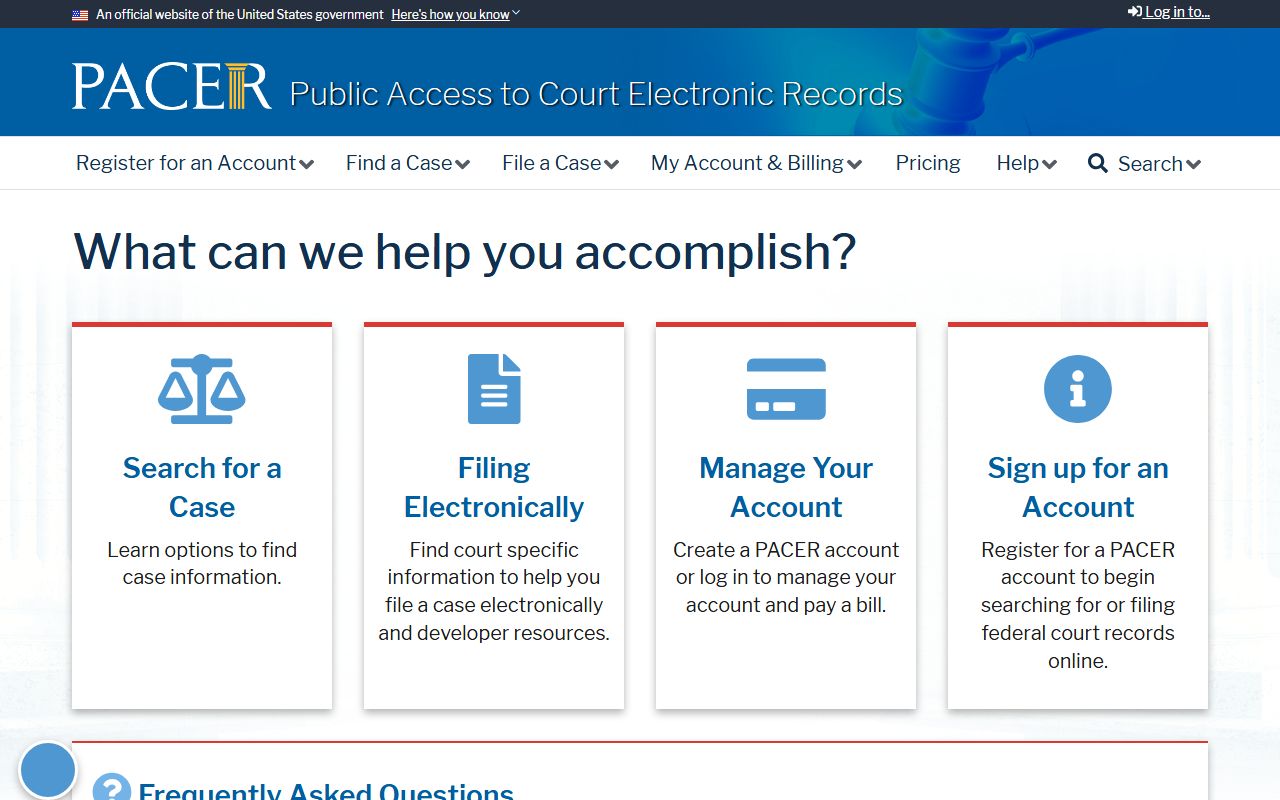
That registration is the gate to federal records that no county office controls.
PACER charges fees subject to the current fee schedule, with a quarterly waiver threshold for light users. A free alternative exists for many documents. CourtListener and its RECAP archive hold copies of federal dockets and documents that users have contributed. It is not the official docket, but it can save money on files others have already pulled. For more on federal venue and appeals, see the Thurston County federal courts page.
Exemptions and Limits
Openness is the rule, but several files stay closed. Some are sealed by court order. Others are confidential by statute. A request that asks for protected material will be denied or redacted, and the agency or court should cite the basis.
Note: Sealed court records under GR 15, juvenile records under RCW 13.50.260, and protected identifiers like Social Security numbers stay out of public view, and incarcerated requesters face special penalty limits under the Public Records Act.
Confidential and sealed court records sit behind GR 15, which protects them from public examination. Juvenile records carry their own sealing process. Adoption and dependency files are closed. Mental health and civil commitment records are restricted. Protected identifiers, such as account numbers, minor names, and addresses in Address Confidentiality Program cases, are redacted before release. Reopening a closed record usually takes a motion and a showing of legal authority.